
The Cybertruck Is Ending: Why People Didn't Buy It, and What Happens to Resale Values
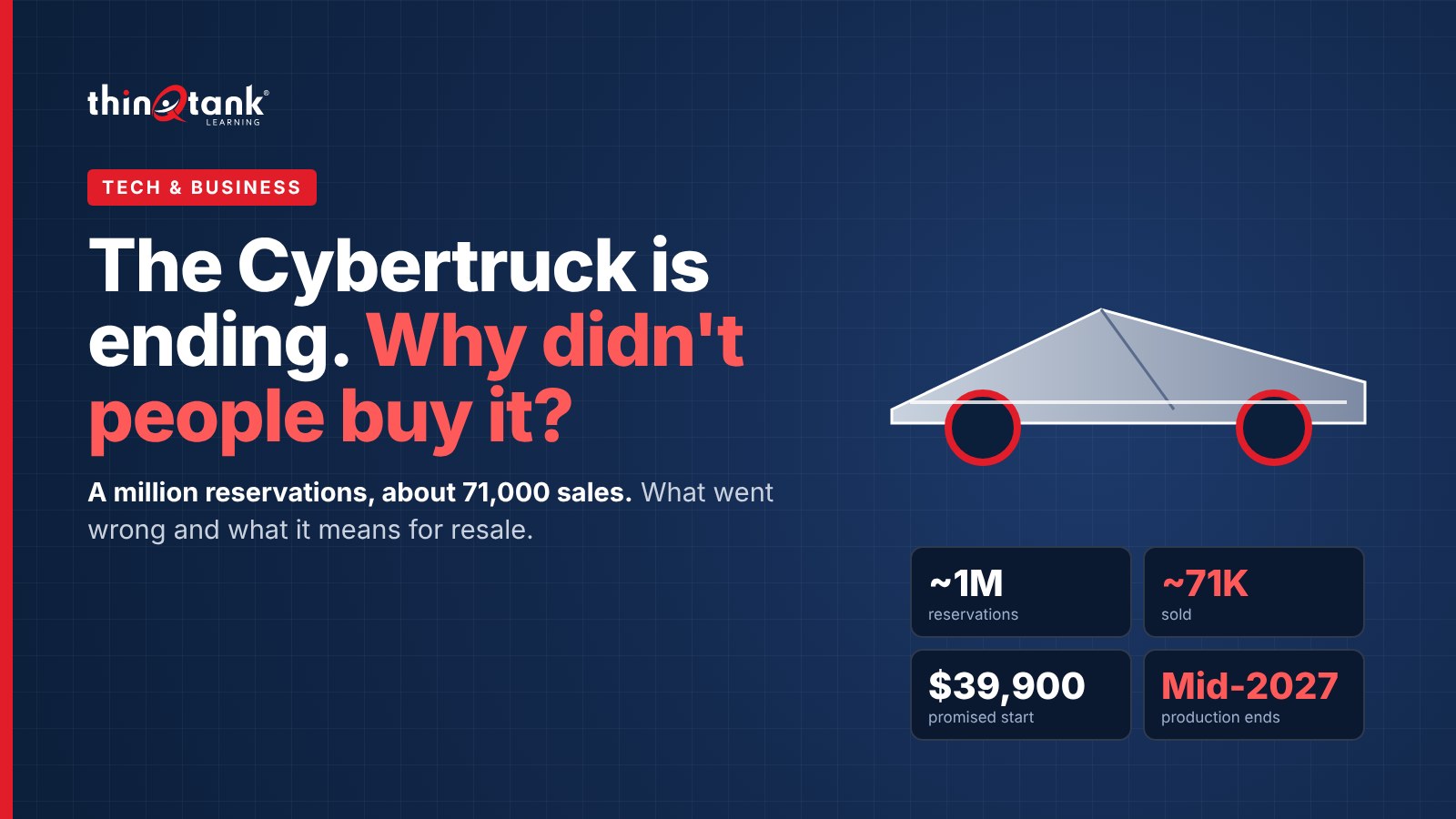
On November 6, Elon Musk announced that Tesla will wind down Cybertruck production at Giga Texas around the middle of 2027, to free up space for its Cybercab robotaxi. The truck that drew more than a million reservations when it was unveiled in 2019 will end its run after roughly three and a half years of deliveries, at about a tenth of the volume it was built for. Here's what happened, what it means for resale values, and why so few of the people who reserved one ever bought it.
~1MReservations Musk cited ~71KTrucks sold since late 2023 (industry estimate) 250KTrucks a year the line was planned for 2027Production winds down around mid-year What happenedThe announcement
Musk posted the news on X on November 6, saying the space was needed for Cybercab production. On November 9 he added that Tesla would build as many trucks as it can in the remaining months and would have to return deposits to a lot of people. He also argued the truck wasn't unprofitable, saying the decision was about the opportunity cost of building such a complex vehicle compared with more Cybercabs.
The sales numbers tell the rest of the story. Tesla doesn't report Cybertruck sales on their own, but Cox Automotive estimates put U.S. sales near 39,000 in 2024, then down about 48% in 2025. By the second quarter of 2026, quarterly sales were estimated at around 3,700, compared with more than 14,000 in the third quarter of 2024. Electrek reported that Musk's own companies bought about 19% of U.S. Cybertruck registrations in one quarter of 2025, with SpaceX alone taking 1,279.
Promised in 2019 vs. delivered
Starting price$39,900 promised$82,490+ after the Nov 2026 increases Best range500+ miles promised325 miles (EPA) Annual volume250,000 planned~30,000 Promised or plannedDelivered or estimated The question everyone's askingWhy didn't people buy it?
1The price more than doubled
The 2019 pitch was a truck starting at $39,900. When deliveries began in late 2023, the cheapest version was $60,990, and the launch Foundation Series ran about $100,000 to $120,000. A cheaper dual-motor trim appeared in 2026 at $59,990, then climbed to $74,990 by August. Many of the people who reserved at $40,000 weren't $80,000 truck buyers.
2The range fell short of the promise
Tesla promised 500+ miles. The best EPA rating was 325, and the range-extender battery pack meant to push it past 470 miles was canceled in 2025. Range matters most to the people trucks are built for: those who tow, where range drops sharply.
3It arrived two years late into a cooling market
Deliveries started almost two years after the original target. By then, rivals were on sale, EV pickup demand was softer than everyone expected, and even Ford's F-150 Lightning peaked at about 33,500 sales a year.
4Quality problems and recalls
Torque News counts 11 recalls since late 2023, including one in March 2025 covering more than 46,000 trucks for a light bar that could come loose. Owners also reported long waits for repairs on parts unique to this truck.
5A design and a brand that divided buyers
The stainless steel wedge made the truck instantly recognizable and just as instantly polarizing. Analysts also pointed to the Tesla brand becoming politically charged, which shrank the pool of buyers willing to drive something so conspicuous.
6It could only sell in one big market
Its design kept it out of Europe and most right-hand-drive countries, and Tesla canceled plans for Australia and New Zealand in October. A factory planned for 250,000 a year was left relying almost entirely on U.S. buyers.
For ownersWhat happens to resale values?
This is where you have to separate the headlines from the data.
- Early buyers took the biggest hit. Early trucks that sold new for about $100,000, and briefly flipped at auction for up to $150,000, were trading around $58,000 to $70,000 by mid-2026, according to figures Autoblog reported from car reviewer Doug DeMuro. That's roughly 30% to 40% below the original sticker in two years, and he predicted further declines.
- The overall used market has been mixed. CarGurus showed average used prices around $81,000 to $83,000 in May 2026, slightly up from a year earlier, as Tesla kept raising new prices. Some owners have reported strong trade-in offers. Others have reported big losses.
- The discontinuation cuts both ways. Right after the announcement, Tesla raised new-truck prices again by $2,500 to $7,500 depending on trim. That can prop up used values in the short term. Over the long term, the bigger question is parts. The stainless body panels, castings and steer-by-wire system are unique to this truck. Tesla's lead engineer has said spare parts and service will continue, but Tesla hasn't said for how long. As EVs for Idiots put it, a discontinued truck could become a collector's item or an orphan that is hard to insure, repair and sell.
If you own one: keep complete service records, make sure every open recall is done, ask your service center how body repairs will be supported, and get offers from more than one buyer before you sell.
The real costIs it more expensive to own now?
The Cybertruck was already one of the costlier vehicles to keep on the road, and the end of production adds a new risk on top.
$Repairs were already steep
One owner was quoted $13,304 by Tesla to fix minor damage to the front grille: 75 parts, about 37 hours of labor and roughly three months in the shop. Another reported a five-month wait and $63,000 in repairs.
%Insurance runs well above average
Full coverage averaged about $4,415 a year in April 2026, according to Insurance.com, compared with $3,037 for the average vehicle. In 2024, Geico declined to renew some personal Cybertruck policies, citing the truck's weight and potential challenges with parts availability.
?Parts are the new question mark
Tesla's lead engineer has said spare parts and service will continue, but Tesla hasn't said for how long. The stainless body panels, castings and steer-by-wire parts are made only for this truck, and parts for low-volume, discontinued vehicles tend to get slower and pricier to source over time. That hasn't been documented yet, but it's a real risk to plan for.
The honest answerWas it a bad buy?
It depends on what you paid and why you bought it. For the earliest buyers, the math is rough: trucks that cost about $100,000 new were trading 30% to 40% lower within two years, insurance runs about 45% above the average vehicle, and minor body repairs have run into five figures. Now add owning a low-volume vehicle whose unique parts will only get rarer once production stops.
If you bought it as an investment, it hasn't been one. If you bought it because you love driving it and plan to keep it, the case is different. Just budget for higher insurance and longer repair times, and ask your service center now how body repairs will be supported after 2027.
The takeawayA project lesson every tech professional will recognize
Strip away the stainless steel and the Cybertruck is a classic project case study. The scope was set by a spectacular demo. The price, range and schedule promised at the unveiling all slipped. The capacity was built for the most optimistic forecast instead of real demand. And customer interest that looked enormous, a million reservations at $100 each, turned out to be cheap to give and cheap to walk away from.
Anyone who's managed a product launch, a migration or a software release has seen a smaller version of this. Validate demand before you build for it, protect the requirements that matter most to your customer, and when the baseline moves, say so early. That's what project management training is really about.
Manage projects that land
Live PMP, CAPM and Agile training with certified instructors, built around real-world case studies like this one.
See PMP class dates Book a 10-minute call— Scott
Sources- Electrek: Tesla to end Cybertruck production as sales stall at ~10% of plan (Nov 6, 2026)
- TechCrunch: Musk says Tesla will refund some Cybertruck deposits (Nov 9, 2026)
- Torque News: 5 reasons the Cybertruck didn't catch on (Nov 6, 2026)
- InsideEVs: What went wrong with the Cybertruck
- Autoblog: Cybertruck buyers who paid $150,000 face a price collapse (June 2026)
- CarGurus: Used Tesla Cybertruck price trends
- Torque News: Tesla quoted $13,304 to fix a minor fender bender (July 2024)
- Insurance.com: Tesla Cybertruck insurance cost (April 2026)
- Notebookcheck: Geico cites Cybertruck repairability in non-renewals (Oct 2024)
- EVs for Idiots: Tesla Cybertruck discontinued, what owners should know